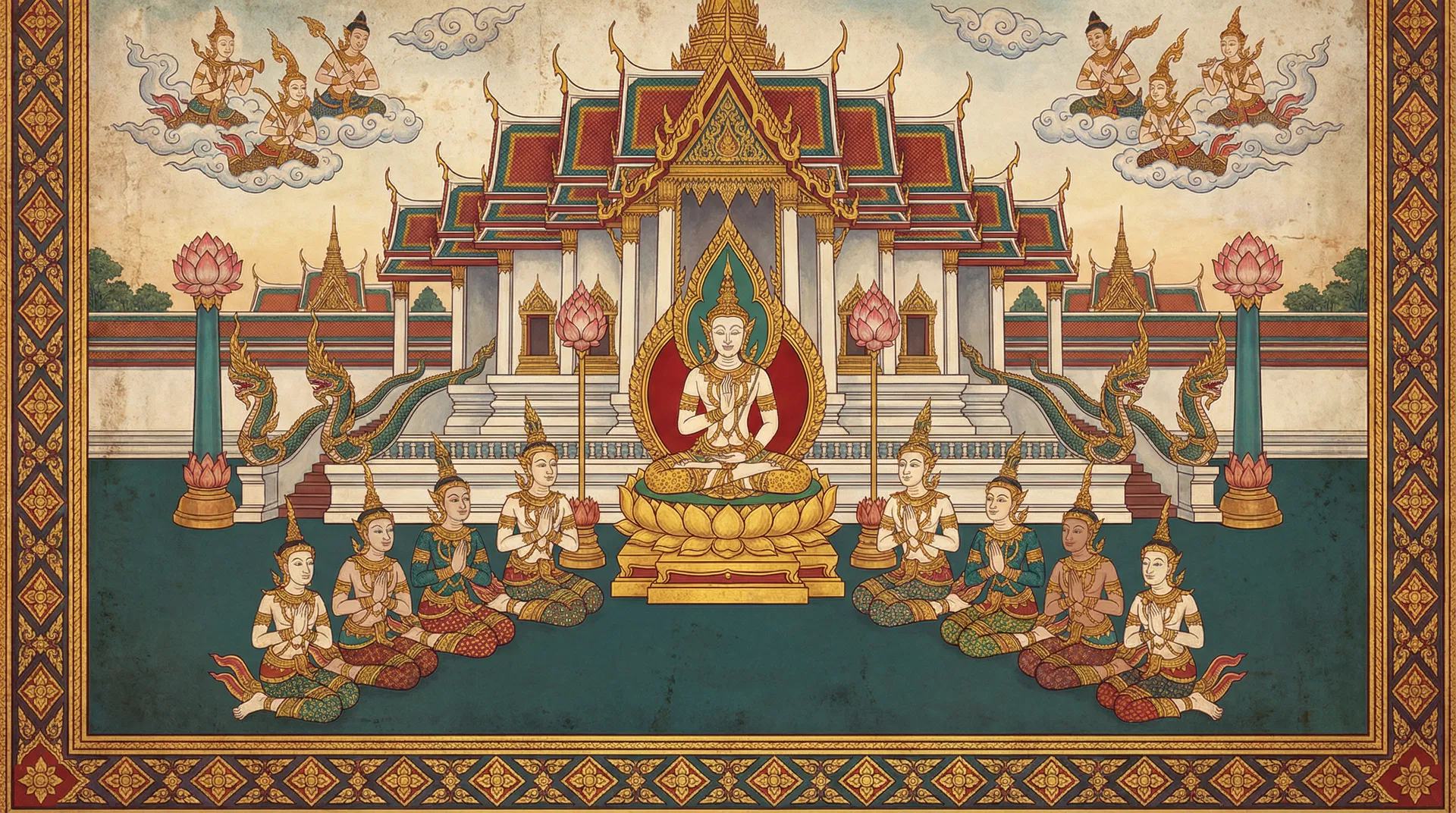
Kacchapa Jataka
Kacchapa Jataka
In the heart of a lush forest, where ancient trees whispered secrets to the wind and a crystal-clear river snaked its way through emerald plains, lived a wise and venerable tortoise. This was no ordinary tortoise; he was the Bodhisatta, destined to embody great compassion and wisdom. His shell, worn smooth by the passage of time and countless seasons, bore the marks of a life lived fully. He dwelled in a serene pond, its waters teeming with life, a sanctuary for all creatures who sought peace and refuge.
One scorching summer, the sun beat down relentlessly, turning the once-vibrant forest into a parched and desolate land. The rivers dwindled to trickles, and the pond, the Bodhisatta's home, began to shrink. Fear, a cold serpent, began to coil around the hearts of the forest dwellers. The deer, their ribs showing, stumbled weakly, their tongues lolling. The birds, their songs hushed, perched listlessly on dry branches. Even the mighty lion, his roar replaced by a mournful sigh, felt the pangs of thirst.
Amidst this widespread despair, a delegation of forest animals approached the Bodhisatta tortoise. Led by a brave but anxious monkey, they bowed their heads, their voices trembling. "Great Tortoise," the monkey chattered, his eyes pleading, "our lives are in peril. The waters are disappearing, and soon, we will all perish. We have heard of your wisdom and your strength. Is there no hope? Can you not help us find a new home, a place where water flows abundantly?"
The Bodhisatta, his ancient eyes reflecting the sorrow of his companions, nodded slowly. "Fear not, my friends," he said, his voice a deep, comforting rumble. "I have seen many droughts, and I have always found a way. There is a great lake, far to the north, beyond the treacherous mountains. It is said to be a paradise of water, untouched by the harshness of this season. But the journey is perilous, and the mountains are a formidable barrier."
A murmur of hope, fragile yet persistent, rippled through the assembled animals. "We will follow you, Great Tortoise!" cried a young deer. "We trust in your guidance!" echoed a wild boar. But how could they reach this distant haven? The mountains were too high to climb, too vast to traverse on foot.
The Bodhisatta, after a moment of deep contemplation, revealed his plan. "I cannot carry you all," he admitted. "But I can help you reach the foothills. We will travel together as far as my strength allows. Then, we will seek the aid of the birds." He explained that he would fly, carried by two powerful cranes, their wings beating against the sky. They would take him to a point from which he could guide the other animals.
The animals marveled at the Bodhisatta's ingenuity. The cranes, noble birds with impressive wingspans, agreed to help. They grasped the Bodhisatta's legs gently, their powerful wings lifting him into the air. As they soared above the parched forest, a collective sigh of awe rose from the creatures below. They watched their savior ascend, a beacon of hope against the unforgiving sky.
The journey was arduous. The sun beat down even at great altitudes, and the wind buffeted the cranes. But they persevered, their dedication to the Bodhisatta unwavering. As they approached the foothills of the northern mountains, the Bodhisatta instructed the cranes to lower him. He landed softly, his shell a familiar comfort to him. He then turned to the cranes, his heart full of gratitude. "My noble friends," he said, "I thank you for your immense kindness. Now, I must guide my earthly companions. Can you carry a message for me?"
The cranes readily agreed. The Bodhisatta then turned his attention to the animals who had followed him. "From here, we must continue on foot," he announced. "But the path ahead is fraught with danger. There are precipices and ravines that even the strongest among you cannot overcome. I will go ahead and find the safest route. You must wait here, and do not speak to anyone you meet, nor try to find me. Your lives depend on your silence and your obedience."
With that, the Bodhisatta began his solitary trek through the rugged terrain. He moved with surprising agility for his age, his determination a silent force. He scouted ahead, carefully assessing each step, seeking the safest passage. He marked the path with his keen eyes, ensuring it was navigable for the herd.
Meanwhile, a group of hunters, their faces hardened by the wilderness, roamed the mountains, seeking game. They were skilled trackers, their senses sharp. As they ventured deeper into the mountains, they came across a remarkable sight: two magnificent cranes, standing patiently beside a group of anxious animals. The cranes, true to their word, remained silent, their gaze fixed on the path ahead.
The hunters were astonished. They had never seen such a sight. Curiosity, a powerful temptress, began to stir within them. "Who are these birds?" one hunter whispered to another. "And why are they with these animals?" They approached cautiously, their spears at the ready. Seeing the animals gathered, and the cranes standing so still, one hunter, emboldened by a foolish impulse, decided to try and provoke a reaction. He grabbed a long, dry stick.
Suddenly, the Bodhisatta, who had been observing from a hidden vantage point, realized the danger. He knew the animals' lives depended on their silence. He saw the hunter approaching the cranes, the stick in his hand. The Bodhisatta, despite his own precarious situation, felt a surge of protectiveness. He knew he had to act, but he also knew that direct confrontation would not work.
He remembered the hunter's desire for a trophy, for a story to tell. A daring, almost desperate, idea formed in his mind. He called out to the cranes, his voice echoing through the mountains. "Noble cranes! Take me away! I must depart!"
The cranes, startled by his sudden command, looked at him with confusion. But they were loyal. Without question, they grasped his legs and lifted him into the air. As the Bodhisatta ascended, the hunter, seeing the cranes take flight with the tortoise, was mesmerized. He had never witnessed such a spectacle. The sight of the Bodhisatta being carried away by the cranes was so astonishing, so unbelievable, that he completely forgot about the animals waiting below.
He watched, spellbound, as the cranes and the tortoise disappeared over the mountain peaks. His companions, equally awestruck, gathered around him, their faces a mixture of disbelief and wonder. "Did you see that?" one exclaimed. "It was a flying tortoise!" another stammered. The hunter, his mind buzzing with this extraordinary event, immediately abandoned his hunt. He raced back to his village, eager to share his unbelievable tale.
The animals, left behind, remained silent, just as the Bodhisatta had instructed. When the hunters, their minds still reeling from the flying tortoise, eventually moved on, the animals were safe. The Bodhisatta, having safely navigated the treacherous mountain pass, returned to guide them. He led them through the safe route he had discovered, and eventually, they all arrived at the great lake, a haven of cool, abundant water. They drank their fill, their thirst quenched, and their spirits revived. They lived there happily, forever grateful to the wise and compassionate Bodhisatta tortoise, who had, through his wisdom and daring, saved them all.
— In-Article Ad —
💡Moral of the Story
True leadership involves wisdom, foresight, and the willingness to make difficult choices for the well-being of others. Sometimes, a daring act of deception, when motivated by compassion, can save lives.
Perfection: Wisdom (Prajna), Compassion (Karuna), Skillful Means (Upaya)
— Ad Space (728x90) —
More Jataka Tales You May Enjoy
 195Dukanipāta
Mahanaradajataka
Mahanaradajataka In the magnificent city of Indrapura, ruled a wise and benevolent king named Brahma...
💡 True enlightenment and ultimate happiness are found not in external pursuits or mythical treasures, but within the awakened mind. Wisdom is the key that unlocks the door to liberation, enabling us to overcome internal obstacles and realize our true nature.
 79Ekanipāta
The Tale of the Great Lotus
The Tale of the Great Lotus In the days of yore, when the world was a tapestry of verdant forests a...
💡 Envy and susceptibility to incitement can lead to ruin. Prudent consideration and compassion are essential for governance.
5EkanipātaThe Monkey King's Sacrifice
The Monkey King's SacrificeIn the dense, emerald heart of the Vindhya Mountains, where ancient trees...
💡 True leadership is defined by selfless sacrifice for the well-being of others.
7EkanipātaThe Steadfast Deer
The Steadfast DeerIn the serene and emerald expanse of a sacred grove, where ancient banyan trees sp...
💡 Unwavering steadfastness and a pure heart can overcome the direst of circumstances.
4EkanipātaThe Tale of the Excellent Archer
The Tale of the Excellent Archer In the ancient kingdom of Mithila, a land blessed with fertile pla...
💡 Accusing others without reason and having impure intentions inevitably lead to one's own suffering. Forgiveness and genuinely good deeds are the path to peace and happiness.
 440Dasakanipāta
Sama Jataka
The Bodhisatta's Compassion for All BeingsIn the lush, verdant forests of the Himalayas, lived a wis...
💡 The highest form of compassion includes forgiveness, even towards those who have caused immense suffering. True peace and reconciliation can be achieved when individuals and rulers embrace righteousness, kindness, and the understanding that all beings deserve protection and love.
— Multiplex Ad —